A record written in lucky rock
Dinosaurs ruled for some 165 million years, from about 233 million years ago until an asteroid struck what is now Mexico's Yucatán Peninsula, 66 million years ago. But the rock that holds their bones was never laid down evenly, and much of it has since been ground to dust. Half of all finds come from the last 35 million years alone.
Most finds are dated only to a geological stage, a window that can be ten million years wide. Each find is placed at a random point inside its own window, so the chart shows the spread the evidence allows rather than piling every find onto the middle of its stage. The thickness of each band is the number of finds. Millions of years ago, oldest on the left.
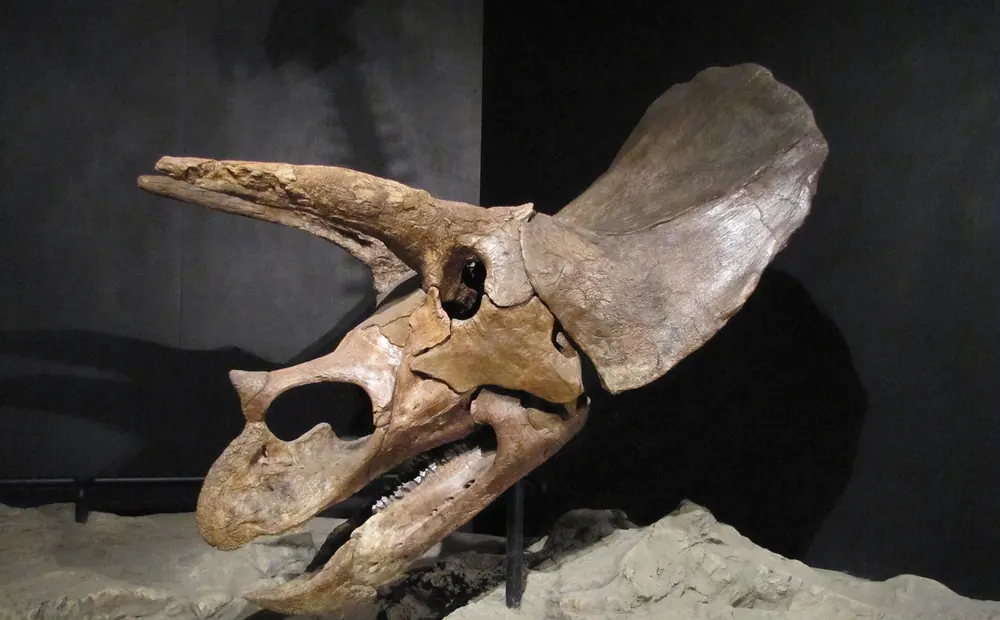
That swell on the right is not a population boom. It is geography: a few rock layers so rich that paleontologists return to them summer after summer. Dinosaur Park in Alberta, where the eroding badlands of the Red Deer River have given up some of the most complete skeletons ever found. Two Medicine and Judith River in Montana. And at the very end, Hell Creek, Lance and the Nemegt of Mongolia. Pick the last few million years and you are standing in the world of .
The smaller peak, around 150 million years ago, is mostly one layer too: the Morrison Formation, a vast sheet of ancient river sand that stretches from Montana to New Mexico. It is the land of the giants, and the long-necks surge.
Teeth, claws and beaks
Theropods, the two-legged hunters that ranged from crow-sized raptors to the 12-meter Tyrannosaurus, lead the count by a wide margin. Part of the reason is in their mouths. A theropod shed and regrew teeth all its life, scattering them like litter, and some of the most common names in the database, such as Richardoestesia and Paronychodon, are known almost only from those lost teeth.
Diet tracks family closely. Click , and nearly all of them turn out to be theropods too: ostrich-mimics and beaked oddities that gave up a strict diet of meat. Then follow the dinosaurs back to the timeline and watch them appear and vanish.
Where the bones come out of the ground
Three in ten finds come from the United States. That reflects geology and history more than where dinosaurs actually roamed. The badlands of Montana, Wyoming and Utah expose exactly the right rocks, and collectors have worked them since the 1870s, when the bitter rivals Edward Drinker Cope and Othniel Charles Marsh raced each other across the West. Today much of the new growth comes from China, Argentina and Brazil.
The United States has led in every period. Follow the other lines, though. Britain, third before 1950, has slipped to ninth, while Spain climbed from near the bottom to second place in the 2000s and 2010s. In the 2020s, Argentina and Brazil are the risers.
Pick and the cast changes. This is the Gobi Desert, where Roy Chapman Andrews's expeditions found nests of fossil eggs in the 1920s, and where Protoceratops, Velociraptor and Tarbosaurus, an Asian cousin of T. rex, weather out of red sandstone cliffs. China, meanwhile, is the world's egg basket: pick it, and the eggs share further down the page jumps.
A world on the move
Every dot on this map is a place where bones, teeth, eggs or footprints came out of the ground. The clusters trace the badlands of the American West, the Gobi, the red cliffs of Patagonia and the farm country of northeastern China: places where the right rock lies at the surface and someone came looking.
Each dot gathers the finds in a two-degree square of today's map, sized by how many there are. Ancient positions come from a model of moving tectonic plates (Merdith and colleagues, 2021), which moves each find back to the middle of its own dated range. The land shapes are today's coastlines carried back with their plates, at the moment closest to the average age of the finds on the map; ancient shorelines and shallow seas are not drawn.
None of those places sat where it sits today. The continents have drifted for the whole of dinosaur history, a few centimeters a year, about as fast as fingernails grow. Switch the map to When they lived and every find slides back to where its rock lay when the animal died.
Pick the , and the first dinosaurs crowd onto Pangaea, a single supercontinent reaching from pole to pole. By the it is splitting along a young, narrow Atlantic, and the giants of the Morrison lived just across the water from their cousins in Portugal. In the the map looks almost familiar, but India is still an island drifting north toward Asia. What the map can't show is the shallow sea that then flooded the middle of North America. T. rex and Triceratops lived on its western shore, on a long strip of land now called Laramidia.
Buried in a flood
A dinosaur became a fossil only if something buried it fast, before scavengers and weather could pull it apart. Rivers in flood did that best, smothering carcasses in sand and mud, so most finds come from ancient channels and floodplains. A few hundred lie in rock laid down in the open sea: bodies that drifted out, bloated, and sank.
Compare , the Late Jurassic home of Allosaurus, Stegosaurus and Diplodocus, with , which preserves the last two million years before the impact. Or see which dinosaurs ended up .
The hunters
In 1824 the English geologist and clergyman William Buckland described a jaw lined with blade-like teeth and named its owner Megalosaurus, the first dinosaur ever named. For a century and a half afterward, finds came in a trickle. Then the pace exploded: six in ten finds in the database were published after 2000, many of them from China, where in 1996 a farmer in Liaoning Province split open a slab and found Sinosauropteryx, the first dinosaur known to have feathers.
The lonely spike in 1865 is a single book: the catalogue of Edward Hitchcock's collection at Amherst College, published by his son the year after he died. Hitchcock spent decades gathering slabs of Connecticut Valley sandstone printed with three-toed tracks, which he believed giant birds had made. About 2,400 finds in the database are footprints like his, and 1,000 are eggs. Pick , and the timeline above slides back to the Early Jurassic, when those New England tracks were pressed into muddy lake shores.
Who is in your selection
These are the most common named dinosaurs among the finds you have picked. Many fossils can only be placed in a family, "a theropod tooth" or "a duck-bill vertebra," so they don't appear here. Click a name to follow it through every chart.
Explore everything
Every chart from this page in one place, sharing the same selection. Drag on the timelines, click bars, and watch the rest update. Your selection is kept in the page address, so you can share it.